"Linksys Wireless Repeater" on Amazon.com

FREE SEARCH

Friday, March 1, 2024

Linksys Wireless Repeaters: A Cost-Effective Solution for Improved Wi-Fi Performance

In today's interconnected world, a strong and reliable Wi-Fi connection is crucial for both personal and professional use. However, many homes and offices face the challenge of weak or inconsistent Wi-Fi signals, leading to frustrating internet experiences. Fortunately, Linksys wireless repeaters offer a cost-effective solution to enhance Wi-Fi performance and eliminate dead zones. This article will explore how Linksys wireless repeaters can improve your Wi-Fi performance without breaking the bank.


Understanding Linksys Wireless Repeaters:

Linksys wireless repeaters are devices designed to extend the range and coverage of your existing Wi-Fi network. They work by receiving the Wi-Fi signal from your router and amplifying it, effectively expanding the coverage area. This allows you to enjoy a strong and stable connection in areas that were previously plagued by weak signals or dead zones.


Cost-Effectiveness of Linksys Wireless Repeaters:

One of the key advantages of Linksys wireless repeaters is their cost-effectiveness. Instead of investing in expensive networking equipment or resorting to complex installations, a wireless repeater offers an affordable and straightforward solution. Linksys repeaters are available at various price points, allowing you to choose a model that fits your budget without compromising on performance.


Easy Installation and Setup:

Linksys wireless repeaters are designed with user-friendliness in mind. Most models feature a plug-and-play setup, eliminating the need for technical expertise or professional assistance. With simple instructions and intuitive interfaces, you can have your repeater up and running in no time, extending your Wi-Fi coverage effortlessly.


Improved Wi-Fi Performance:

By strategically placing a Linksys wireless repeater in your home or office, you can experience significant improvements in Wi-Fi performance. The repeater captures the existing Wi-Fi signal and rebroadcasts it, effectively boosting the signal strength and extending the coverage area. This ensures a more reliable connection, faster speeds, and reduced latency, allowing you to stream, browse, and work seamlessly across all areas of your space.


Eliminating Wi-Fi Dead Zones:

One of the most frustrating aspects of a weak Wi-Fi signal is encountering dead zones, where the signal is virtually non-existent. Linksys wireless repeaters effectively eliminate these dead zones, ensuring that every corner of your home or office has a strong and stable Wi-Fi connection. Whether it's a basement, an upper floor, or an outdoor area, a properly placed repeater can bridge the gap and provide consistent coverage.


Compatibility and Scalability:

Linksys wireless repeaters are designed to be compatible with a wide range of routers and Wi-Fi standards. This means that regardless of your existing network setup, you can find a Linksys repeater that seamlessly integrates and enhances your Wi-Fi performance. Additionally, if your network needs change or expand in the future, Linksys repeaters offer scalability, allowing you to add more repeaters to further extend your coverage.


Conclusion:

Linksys wireless repeaters offer a cost-effective and practical solution for improving Wi-Fi performance in homes and offices. With easy installation, improved coverage, and compatibility with various routers, these repeaters provide a seamless and reliable Wi-Fi experience. Say goodbye to frustrating dead zones and weak signals, and embrace a stronger and more consistent connection with Linksys wireless repeaters. Invest in a Linksys repeater today and enjoy the benefits of enhanced Wi-Fi performance without breaking the bank.


Choosing the Right Linksys Wireless Repeater for Your Home or Office

In today's digital age, having a strong and reliable Wi-Fi connection is essential, whether you're at home or in the office. One of the best ways to ensure a robust Wi-Fi signal in every corner of your space is by using a wireless repeater, such as those offered by Linksys. This article will guide you through the process of choosing the right Linksys wireless repeater for your specific needs.


Firstly, it's important to understand what a wireless repeater does. Essentially, it extends the range of your existing Wi-Fi network, ensuring that the signal reaches further and covers more area. This is particularly useful in larger homes or offices where the Wi-Fi signal may not reach all rooms or areas.


When choosing a Linksys wireless repeater, there are several factors to consider:


1. Size of Your Space: 

The size of your home or office will determine the range you need from your repeater. Linksys offers a variety of models with different ranges, so choose one that can cover your entire space. 


2. Number of Devices: 

Consider the number of devices that will be connecting to the Wi-Fi network. If multiple devices will be used simultaneously, you'll need a repeater that can handle that capacity.


3. Wi-Fi Standards: 

Ensure that the repeater you choose supports the same Wi-Fi standard as your router (e.g., Wi-Fi 5 or Wi-Fi 6). This will ensure compatibility and optimal performance.


4. Ease of Setup: 

Look for a repeater that offers an easy setup process. Many Linksys models feature a simple plug-and-play setup, making it easy for even the least tech-savvy individuals to install.


5. Security Features: 

Security is a crucial aspect of any Wi-Fi network. Choose a repeater that supports WPA or WPA2 security protocols to keep your network secure.


6. Budget: 

Finally, consider your budget. Linksys offers a wide range of repeaters to suit different price points, so choose one that offers the features you need at a price you're comfortable with.


In conclusion, choosing the right Linksys wireless repeater involves considering your specific needs and circumstances. By taking into account the size of your space, the number of devices, the Wi-Fi standards, the ease of setup, security features, and your budget, you can find the perfect repeater to ensure a strong and reliable Wi-Fi connection in your home or office.


Sunday, August 12, 2018

Configuring an Access Point as a wireless repeater

The Linksys Wireless-G Access Points can be configured as an Access Point, Access Point Client, Wireless Repeater, and Wireless Bridge.  The Wireless Repeater mode will turn the access point into a wireless repeater to extend the range of your signal.                      
 
The WAP54G will work as a wireless repeater with the following devices:
  • Linksys Wireless-G Access Point (WAP54G)
  • Linksys Wireless-G Router (WRT54G) 
To configure the access point as a wireless repeater, you need to perform two steps:
  1. Checking the Wireless MAC Address of a Wireless Router/Access Point
  2. Setting-Up Wireless Repeater Mode on the WAP54G  
Checking the Wireless MAC Address of a Wireless Router  
NOTE:  If you will connect the wireless repeater to another WAP54G, click here.  To check the wireless MAC Address of the wireless router follow the steps below.   
Step 1:
Access the router’s web-based setup page.  For instructions, click here. 
NOTE:  If you are using Mac® to access the router’s web-based setup page, click here.
Step 2:
When the router’s web-based setup page opens, click Status then click Wireless. 
Step 3:
Take note of the MAC Address. This is your router’s wireless MAC address. 
NOTE:  The Wireless MAC Address you took note of will be entered on the WAP54G set as wireless repeater.  After checking the wireless MAC Address, set-up the wireless repeater mode on the WAP54G.  For instructions, click here.  To check the wireless MAC address of the access point, follow the steps below.
Checking the Wireless MAC Address of an Access Point 
Step 1:
Connect a computer to the access point. 
Step 2:
Assign a static IP address on the computer.  For instructions, click here. 
NOTE:  To assign a static IP address on a wired Mac, click here.
Step 3:
Open the access point’s web-based setup page.  For instructions, click here. 
NOTE:  If you are using Mac to access the access point’s web-based setup page, click here.
Step 4:
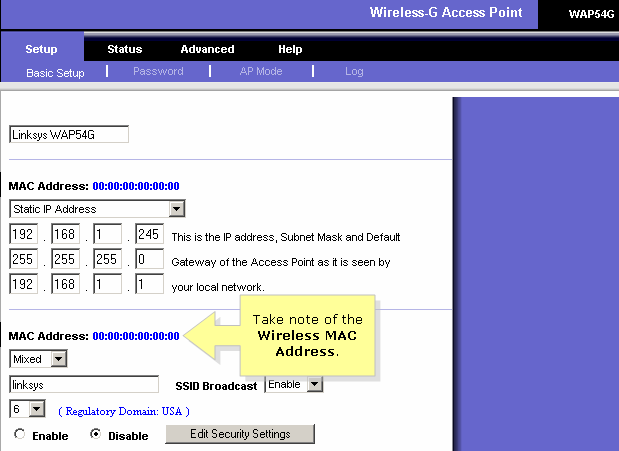
When the access point’s web-based setup page opens, take note of the Wireless MAC Address. 
NOTE:  The Wireless MAC Address you took note of will be entered on the WAP54G set as wireless repeater.  
Step 5:
After obtaining the wireless MAC address of the router/access point, configure the other WAP54G as a wireless repeater.  For instructions, follow the steps below. 
Setting-Up Wireless Repeater Mode on the WAP54G 
Step 1:
Access the access point’s web-based setup page.  For instructions, click here. 
NOTE:  If you are using Mac to access the access point’s web-based setup page, click here.
Step 2:
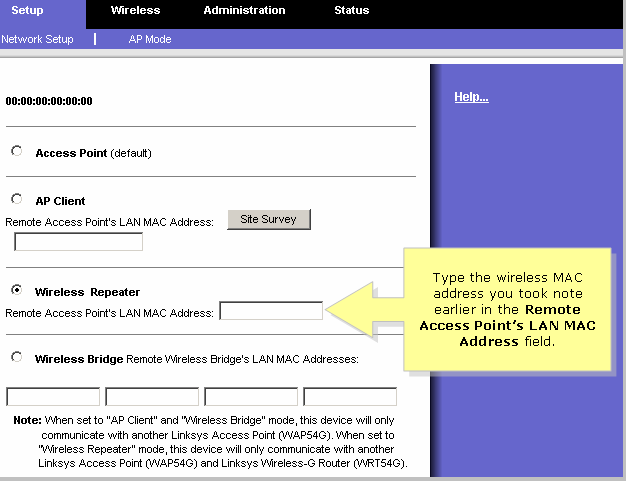
When the access point’s web-based setup page opens, click AP Mode then select Wireless Repeater. 
NOTE:  The access point’s web-based setup page may differ depending on the access point’s version number. 
Step 3:
Type the wireless MAC address you took note of earlier in the Remote Access Point’s LAN MAC Address field.
 
NOTE:  Remove the colons (:) when typing the MAC address on the Remote Access Point’s LAN MAC Address field. 
Step 4:
Click .
NOTE:  If you will connect the wireless repeater to another WAP54G, change the wireless repeater’s LAN IP address.  For instructions, click here.

Sunday, January 13, 2013

Exactly what are the Most Essential Facets of A Wireless Repeater For your Residence?

If you are having trouble in regards to the bandwidth of your connection in your house, or if your signal is often dropped, a wireless repeater might be the resolution for you.

Repeaters are made in order to boost the signal from the modem to your other products. They are generally needed in slightly older houses or bigger houses in which the space from the modem to the computers (for a 2.4 ghz router) is more than roughly thirty to forty-six mtrs. If various other wireless network problem solving was carried out to no avail, it might be time to consider getting a repeater, particularly if you are experiencing reduced wireless transfers in regions of your home away from the modem.

A way to check the connection data transfer rates in your house would be to perform a continuous ping test.

To do a steady ping test, you will have to know your router's IP and also have your computer on line in the area you want to test out the wireless network. Luckily for us, modems usually have the same Ip address of 192.168.0.1.

Now that you realize you'll need a repeater, what kind should you get?

The best way to be sure of the compatibility of the modem and your repeater is to buy a repeater created by the exact same producer as your modem. For instance, for those who have a Linksys device, purchase a Linksys wireless repeater.

If you intend to purchase a repeater to use with a combined connection (both wired and wireless), make sure you invest in a repeater using wireless standard 802.11b/g. That convention should be the same as the standard of the modem, although some repeaters can be compatible with a variety of standards - check the description to find out.

Look at the network set up option on the laptop or computer, select the wireless connection you're looking at, and in the properties menu examine its configuration in order to locate the standard number.

Another essential aspect in repeaters is an Ethernet port or ports. These ports are helpful if you might be troubleshooting the network, therefore it is preferable to buy a repeater which includes these.

Check out wireless repeater reviews to find out more information about each repeater.

For most of us, the install instructions must be user-friendly and easy to read. Often, companies in the industry these days provide you with simple information. If the guidelines are elaborate, or if you require them to be simplified, you might want to hire a expert to do the assembly.

Generally, a repeater ought to be set up in the center of your other wireless network devices. The truth is this isn't always simple to do or even exactly what you will need. While you put in place your repeater, ensure it is inside the reach of your first network. After it is installed, make sure that your wireless repeater's new connection stretches to the place you preferred to make use of it earlier but weren't able to. You might need more than one repeater to cover your entire property.

Repeaters can provide a great benefit in an area where the network speeds happen to be slow. Choosing the best repeater can save you precious time, and frustration.


http://www.articlesbase.com/hardware-articles/exactly-what-are-the-most-essential-facets-of-a-wireless-repeater-for-your-residence-6022138.html

Sunday, October 14, 2012

Cisco-Linksys Wireless-G Range Expander WRE54G

Product Features

  • Dimensions - 1.1 x 7.4 x 6.9 in (H x W x D)
  • Wireless Standard - IEEE 802.11b, IEEE 802.11g
  • Security WEP - 64/128 bit WEP

Product Features and Technical Details

Product Features

  • Dimensions - 1.1 x 7.4 x 6.9 in (H x W x D)
  • Wireless Standard - IEEE 802.11b, IEEE 802.11g
  • Security WEP - 64/128 bit WEP

Technical Details

  • Brand Name: Cisco
  • Model: WRE54G
  • Hardware Platform: Pc
  • Network Switching Protocol: Ethernet
  • Network Transport Protocol: TCP/IP
  • Network Remote Management Protocol: HTTP
  • Network Data Transfer Rate: 54 Megabits Per Second

Product Description

From the Manufacturer

The Linksys Wireless-G Range Expander is the easy way to increase the effective coverage of your wireless network. Unlike adding a traditional access point to your network to expand wireless coverage, the Wireless-G Range Expander does not need to be connected to the network by a data cable. Just put it within range of your main access point or wireless router, and it "bounces" the signals out to remote wireless devices. This "relay station" or "repeater" approach saves wiring costs and helps to build wireless infrastructure by driving signals into even those distant, reflective corners and hard-to-reach areas where wireless coverage is spotty and cabling is impractical. The Range Expander is perfect to help cover large areas in multi-story homes, warehouse environments, public spaces, wireless "Hot Spots", and outdoor venues -- anywhere you need extra coverage for your wireless network.
The Wireless-G Range Expander is compatible with the Linksys WAP54G Access Point, and both the WRT54G and WRT54GS Wireless Routers. It works with both Wireless-G and Wireless-B clients so you'll get the benefits of increased coverage, even with a mixed network.

Product Description

Expand the range of your wireless network The Linksys Wireless-G Range Expander is the easy way to increase the effective coverage of your wireless network. Unlike adding a traditional access point to your network to expand wireless coverage, the Wireless-G Range Expander does not need to be connected to the network by a data cable. Just put it within range of your main access point or wireless router, and it bounces the signals out to remote wireless devices. This relay station or repeater approach saves wiring costs and helps to build wireless infrastructure by driving signals into even those distant, reflective corners and hard-to-reach areas where wireless coverage is spotty and cabling is impractical. The Range Expander is perfect to help cover large areas in multi-story homes, warehouse environments, public spaces, wireless Hot Spots, and outdoor venues - anywhere you need extra coverage for your wireless network.


Thursday, September 6, 2012

Linksys RE1000 Wireless-N Range Extender

Product Features

  • Broad compatibility with b/g/n Wi-Fi devices
  • Extended range with multiple antennas
  • Fast Ethernet (10/100 Mbps) port to connect wired devices
  • Flexible wall or desktop placement options
  • Ideal for enjoying added in-home mobility
  • Ideal for easily connecting an Internet ready TV or Blu-ray player
  • Ideal for surfing the web, gaming, and chatting online in hard-to-reach areas

Product Description

From the Manufacturer

Easily increase wireless network coverage throughout your home. Also works as a bridge to instantly connect wired devices to your network.

Ideal for

  • Enjoying added in-home mobility
  • Surfing the web, gaming, and chatting online in hard-to-reach areas
  • Easily connecting an Internet ready TV or Blu-ray player

Key Features*

  • Broad compatibility with b/g/n Wi-Fi devices
  • Extended range with multiple antennas
  • Fast Ethernet (10/100 Mbps) port to connect wired devices
  • Flexible wall or desktop placement options

Thursday, May 3, 2012

192.168.1.1 in Linksys Wireless Routers

Some of the most efficient and reliable wireless routers are Linksys wireless routers manufactured by Cisco Systems. These routers are characterized by blue and black surfaces. A Linksys wireless router is used to facilitate the connection of a single computer or many computers to the World Wide Web and to a network for file sharing. This router also connects to any available network for such tasks as network printing and file sharing. Such networks are called local area network or LANs. You could get an IEEE 802.11b Linksys wireless router, an IEEE 802.11g Linksys wireless router, or an IEEE 802.11n Linksys wireless router. 192.168.1.1 is the default IP (Internet Protocol) address for all these routers. An Internet Protocol address is basically a numeric identifier assigned to all devices that make up computer networks. Different machines and devices in a network have unique Internet Protocol address. You should only use this IP address for one router. This IP address is more specifically a Class C private Internet Protocols address. While this IP address allows several computers to share an ISP connection, the problem is that in most parts of the world, home computers do not have access to the internet and there is a risk of Trojan horses and viruses.

A Linksys wireless router consists of an inbuilt SPI Firewall, 1 WAN internet port, 4 LAN Ethernet ports, hardware Firewall, press reset, inbuilt DHCP server, and front panel status display. The process of setting up a Linksys wireless router varies depending on the particular router, but it is easy and there is no need to call in an expert. To set up a Linksys wireless router, you will need cable internet connection or DSL and Ethernet cables. First you have to attach the antennas. After this, you need to place the antennas the most central location and you should make sure they are not surrounded by metal because these signals cannot travel through metals. You should also make sure that your router is located in a place such that the distance between your different computers is equal. After plugging in the Ethernet cable into the port located at the back of the router, connect another cable to the Ethernet port of your computer and then attach the free end to the available port of the router. Repeat this process since Linksys wireless routers have several ports. However, you should not use the wide area network or WAN port. The next step is powering the router. There will be some flashing until the booting process is complete. For the changes to take effect, restart the computer.

Configuration is very important in the setup process. To configure the router, go to the home page by typing in the IP address on your browser and then hit 'Enter'. When you do this, you will get a pop up box after which you should use the user name 'Admin' and leave the password blank. Once you are connected, go to the 'Internet Setup' option and key in your specifications. In the pop up box, you will be able to configure such things as the SSID or service set identifier and you will be able to change the password. Other than Linksys wireless routers, this IP address is also used by other routers and in very rare cases printers and computers. The IP address is also used by open-source Linux-based firmware compatible with Linksys routers.

Retrieved from "http://www.articlesbase.com/technology-articles/19216811-in-linksys-wireless-routers-4268408.html"

Saturday, December 24, 2011

Introduction Video of Linksys Wireless Repeater


Linksys Wireless Repeater by Aurora_Rainbow

Friday, September 16, 2011

Linksys Wireless N WRT160N Router - Review

It allows you to access Internet on your personal computer or computer network without the need for a cable connection. You use a wireless router in a LAN. A wireless router has the following features:

1.It has LAN ports, which function very similar to the ports in a network switch

2.It also has a WAN port which allows you to connect to a wider network

3.It has a wireless antenna.

The antenna allows you to connect to other wireless devices such as - wireless repeaters, wireless bridges, Network Interface cards etc. You will find many wireless routers on the market, but not all may be equally effective. One of the best wireless routers that you can use is the Linksys Wireless router. This sleek, flat looking router has a very unique chassis which looks like an UFO. The best feature of this router is that it does not have an external antenna. It has an in-built antenna which gives it a very compact and sophisticated look. This router would cost you about $80.

This cute looking wireless router has standard 4 network ports. The router has an array of diodes which emits lights on the front side. This light emitting diodes shows the status of the wireless network, the Internet and the status of the ports.

When you buy this wireless router, you will get Advisor software which works well with both Windows and Mac. The software provides you step-by-step set-up procedures.

A very striking feature of Linksys Wireless N WRT160N Router is its content filtering system, which is called 'Access Restrictions'. This allows you to restrict access of a particular computer in a network.

Though it offers such great features, it has its own drawbacks. It does not have a USB support. It allows Internet speed of only 100mbps, which is by far very slow.

Read more: http://www.articlesbase.com/computers-articles/linksys-wireless-n-wrt160n-router-review-3237178.html#ixzz1YBCWXM2r
Under Creative Commons License: Attribution No Derivatives

Tuesday, January 11, 2011

How to Configure an Access Point as a Wireless Repeater

The Linksys Wireless-G Access Points can be configured as an Access Point, Access Point Client, Wireless Repeater, and Wireless Bridge. The Wireless Repeater mode will turn the access point into a wireless repeater to extend the range of your signal.

Things You'll Need:

* To configure the access point as a wireless repeater, you need to perform two steps:
* Checking the Wireless MAC Address of a Wireless Router/Access Point
* Setting-Up Wireless Repeater Mode on the WAP54G

1. The WAP54G will work as a wireless repeater with the following devices:

Linksys Wireless-G Access Point (WAP54G)
Linksys Wireless-G Router (WRT54G)

2. Checking the Wireless MAC Address of a Wireless Router

3. Access the router's web-based setup page. For instructions

4. When the router's web-based setup page opens, click Status then click Wireless.

5. Take note of the MAC Address. This is your router's wireless MAC address.

6. Checking the Wireless MAC Address of an Access Point

7. Connect a computer to the access point.

8. Assign a static IP address on the computer.

9. Open the access point's web-based setup page.

NOTE: If you are using Mac to access the access point's web-based setup page

10. When the access point's web-based setup page opens, take note of the Wireless MAC Address

11. After obtaining the wireless MAC address of the router/access point, configure the other WAP54G as a wireless repeater. For instructions, follow the steps below.

12. Setting-Up Wireless Repeater Mode on the WAP54G

13. Access the access point's web-based setup page.

NOTE: If you are using Mac to access the access point's web-based setup page

14. When the access point's web-based setup page opens, click AP Mode then select Wireless Repeater.

15. Type the wireless MAC address you took note of earlier in the Remote Access Point's LAN MAC Address field.

NOTE: Remove the colons (:) when typing the MAC address on the Remote Access Point's LAN MAC Address field.

16. Click (Save Settings)

NOTE: If you will connect the wireless repeater to another WAP54G, change the wireless repeater's LAN IP address.

Tips & Warnings

*
If you will connect the wireless repeater to another WAP54G, click here. To check the wireless MAC Address of the wireless router follow the steps below.
*
The Wireless MAC Address you took note of will be entered on the WAP54G set as wireless repeater. After checking the wireless MAC Address, set-up the wireless repeater mode on the WAP54G. For instructions, click here. To check the wireless MAC address of the access point, follow the steps below.


Read more: How to Configure an Access Point as a Wireless Repeater | eHow.com http://www.ehow.com/how_4773208_configure-access-point-wireless-repeater.html#ixzz1AjokApoJ